







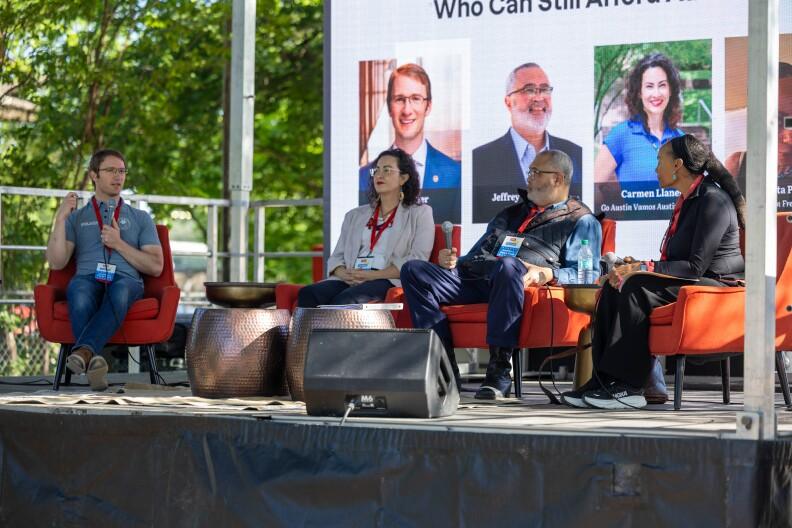
The KUT Festival recently brought the Austin community together for a weekend filled with music and significant discussions about the city’s housing landscape. A panel of local leaders addressed the pressing issue of housing affordability during the inaugural event, highlighting both progress and ongoing challenges.
Moderated by Alberta Phillips of the Austin Free Press, the panel featured Austin City Council Member Ryan Alter, Travis County Commissioner Jeff Travillion, and community organizer Carmen Llanes, who serves as the executive director of Go Austin Vamos Austin. Each panelist tackled a critical question: Who can afford to live in Austin today?
Commissioner Travillion noted that current housing options often cater only to the very wealthy or the very poor, referencing the existence of income-restricted affordable housing. He emphasized that many “regular folks,” including teachers and government employees, struggle to find suitable housing. They must also consider essential amenities like quality schools, health clinics, and public transportation when selecting where to live within Travis County.
Alter pointed out that Austin still has significant work ahead to improve deeply affordable housing, as only 1% of the city’s housing stock is accessible to families earning 30% of the median family income—approximately $133,800 for a family of four. He highlighted that 17% of the local population falls within this lower-income bracket, indicating a substantial gap in available housing options.
Despite these challenges, Alter expressed optimism regarding the city’s efforts to enhance affordability for a broader segment of the population. He attributed recent reductions in housing prices to intentional city planning aimed at preventing the displacement of long-time residents as Austin continues to evolve.
“The city has undergone dramatic reductions when it comes to housing prices due to deliberate actions to make housing more available in more locations,” Alter stated. “When we have more housing, it naturally lowers costs across income brackets, allowing more people to stay here instead of being pushed out to surrounding areas like Buda, Kyle, and Round Rock.”
However, Llanes questioned the effectiveness of Austin’s affordable housing policies, including the Density Bonus 90 program, arguing that they have not adequately addressed the needs of those most affected by rising costs. She claimed that these policies have not significantly curbed displacement and have instead favored wealthy investors over the community.
“We’re not really monitoring where that goalpost is,” Llanes remarked, noting that many communities are finding ways to coexist despite the mounting challenges. She also highlighted the vacancy rates of high-end apartments, indicating a disconnect in the housing market.
Llanes cited a recent zoning change approved by the City Council in 2025 that allowed the redevelopment of Acacia Cliffs, an existing affordable apartment complex. While the developer is required to allocate a portion of the new units at affordable rates under the DB90 program, critics argue this project will ultimately lead to a reduction in affordable housing availability.
Alter acknowledged the complexities surrounding the Acacia Cliffs situation, stating that the council faced a difficult decision. He noted that without the rezoning, the developer could have proceeded without any affordable housing. Alter expressed support for reforming the DB90 program, advocating for more flexible tiers to improve its effectiveness.
“We are trying to use the tools we have to the best of our ability,” he said. “We need to reform DB90 because it’s not working as intended. More flexibility is necessary to avoid a one-size-fits-all approach.”
The Austin City Council is anticipated to vote on a new proposed density bonus program later this month, as discussions around housing affordability continue to unfold.