







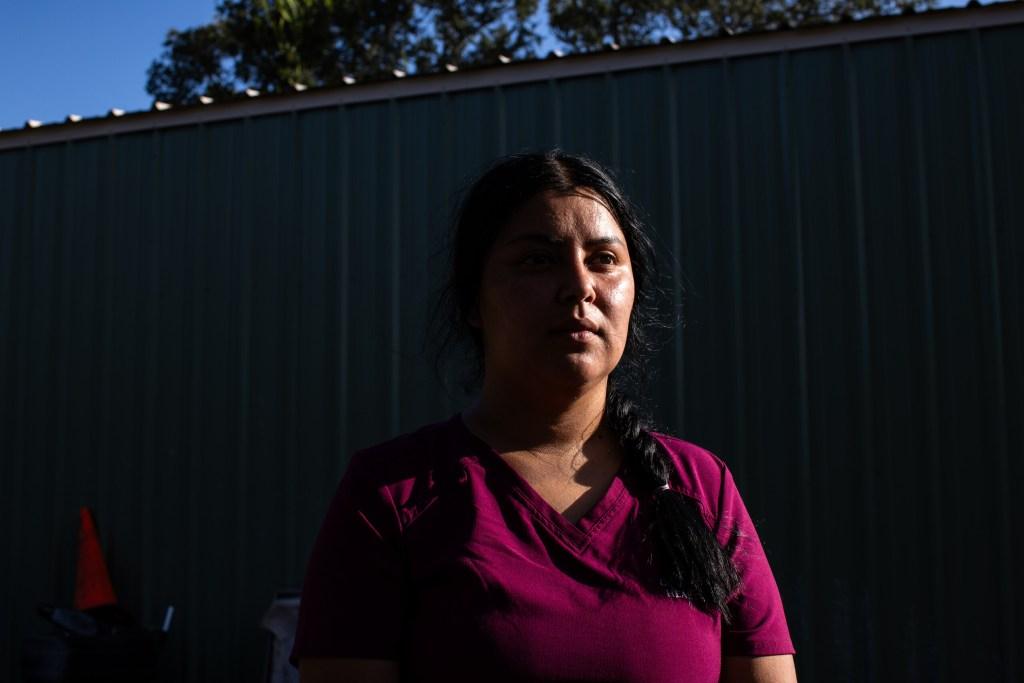
In the heart of Austin, Itzayana Mondragón grew up in a neighborhood where everyone resembled her and shared a common language—Spanish. However, following Donald Trump’s election victory in 2016, she noticed that some friends began to vanish from school. These absences later revealed troubling truths: many were undocumented immigrants who, driven by fear or compelled by circumstances, returned to their home countries as Trump intensified his promised crackdown on illegal immigration.
It was during this turbulent time that Mondragón’s parents had a pivotal conversation with her. They disclosed their undocumented status, as well as her own, explaining that they had crossed the border from Mexico in 2000 when she was just six months old. “I didn’t know I was what people here call ‘illegal’ until high school, when the Trump administration came into office,” Mondragón reflected. “I grew up fearing my parents’ worries about deportation, but the term ‘illegal’ never crossed my mind.”
As the Trump administration escalated border enforcement and deportations, Mondragón, like many long-term residents of the U.S., sought refuge in the Deferred Action for Childhood Arrivals (DACA) program, initiated under President Obama. This program offers legal protections and work permits to individuals who arrived in the U.S. as children. Despite Trump’s attempts to dismantle DACA during his first term, the U.S. Supreme Court ruled against him in 2020, citing his actions as “arbitrary and capricious.” Currently, approximately 500,000 people in the U.S. hold DACA status, with around 80,000 living in Texas.
Encouraged by her parents, Mondragón applied for DACA in 2016. Over the past decade, her status has allowed her to thrive—she became a nurse, a landowner, and a mother. Now 26, she has worked at a clinic for four years, and two years ago, she and her husband purchased a three-acre farm near Cedar Creek, just a half-hour from Austin. Their farm is home to a variety of animals, including chickens and ducks, with their two young children eagerly helping to gather eggs.
However, the shadow of uncertainty looms large. Recently, DACA renewal appointments have been systematically delayed, causing recipients to lose their status and work permits, leading to job losses. Mondragón recounts how a friend was forced to resign her nursing position when her DACA status expired, despite her renewal application being submitted.
Without DACA, recipients can become targets for U.S. Immigration and Customs Enforcement (ICE), which has recently apprehended individuals during renewal appointments or even at routine traffic stops, deporting them to countries they barely know. In light of this threat, Mondragón applied for her renewal six months ahead of her expiration date.
“It’s entirely possible that the administration is slowing down the renewals to circumvent the Supreme Court’s decision,” noted Whitney Drake, managing attorney and co-legal director of American Gateways, a nonprofit providing legal services to low-income immigrant communities. “This administration has been very creative in its attempts to dismantle the immigration system.”
Some business owners in Texas have criticized the administration’s approach to DACA, arguing that it has destabilized their workforce and adversely affected their businesses. Recently, a group of Republican construction leaders from South Texas cautioned their party that deporting workers could cost them votes in the upcoming midterm elections.
Zach Kahler, spokesperson for U.S. Citizenship and Immigration Services, asserted that the agency is “safeguarding the American people by more thoroughly screening and vetting all aliens.”
Among those affected by the ongoing deportation campaign is Mondragón’s family. She has experienced the anxiety of watching her loved ones apprehended by ICE. Three of her brothers-in-law have been deported, with one being arrested after a routine traffic stop for a broken light. Within 24 hours, he was in Mexico.
Collecting their belongings and vehicles to sell has become a grim routine for Mondragón, who has witnessed ICE agents patrolling her Cedar Creek neighborhood, where many residents are Latino. “I experience severe PTSD and anxiety when I see an empty construction truck on the side of the road,” she shared. “You can sense something has happened.”
She vividly remembers a distressing incident at her workplace, where she saw state troopers forcibly remove a mother from her car in a clinic parking lot. Mondragón felt helpless watching the child’s empty car seat as the woman was taken away for missing an ICE appointment. “That broke my heart. I wish I could have done more,” she lamented. “I still haven’t mentally recovered from it.”
To cope, she sees a therapist, takes medication, avoids news updates, and focuses on her farm and children to keep her mind occupied. Prayer also plays a crucial role in her life.
Meanwhile, Jesús Álvarez’s journey to the U.S. began when he was just 12 years old, crossing the Rio Grande on an inflated tire. He and his sister waited for their parents to join them after their father had already made the journey. After enduring bullying in school and working various jobs, Álvarez applied for DACA in 2012 and has been renewing it every two years. However, his most recent renewal expired in April, despite his timely application.
At 34, Álvarez now lives with his wife and two children in his parents’ home, hoping to save enough to buy a place of their own. Yet, without DACA, he finds himself unable to rent or purchase a home and unable to renew his driver’s license—leaving him feeling trapped. “Life here is just work and then home. Now there’s the fear of whether I’ll make it back home to my family,” he expressed. “It’s exhausting to see our own people fleeing from the police.”
Contrary to common misconceptions, Álvarez challenges the narrative that immigrants are taking jobs from Americans. “These people who say, ‘They’re stealing our jobs’—come work alongside us,” he urged. “Why is it a crime to want to feed your family?”
Diana Maldonado’s understanding of her undocumented status has been clearer since her arrival in the U.S. in 2001, when she was 11 years old. After several attempts to cross the Rio Grande with her uncle, she finally made it to Austin. She applied for DACA in 2012 and found work cleaning houses. In 2024, she traveled to Mexico for the first time after obtaining a permit to return without losing her DACA status. However, her perspective shifted during that visit, as she realized her true home is now in the U.S.
Now 36, with a 21-year-old son in college and a 16-year-old daughter, Maldonado’s life took a turn when she was diagnosed with a tumor in her ear, leading to surgery and a temporary halt in her work. She applied for DACA renewal in December, but it expired in February, leaving her anxiously awaiting updates on her application.
With her DACA status expired, every drive brings panic for her children, who worry she may not return home. “I don’t want to feel far from home again,” she said, emphasizing her need for stability.
To honor those torn from their lives by ICE, Mondragón created a small altar to the Virgin of Guadalupe on her farm. After a challenging period of searching for a statue, a stranger miraculously appeared to sell her one. The day after she completed the altar, her DACA renewal was approved, along with her parents’ visas, allowing them to live legally in the U.S.
Yet, the looming threat of a federal court ruling could ban DACA recipients from working in Texas, forcing them to relocate for legal employment. This legal battle began in 2018 when Texas Attorney General Ken Paxton joined other states to challenge the DACA program, claiming it was illegal and financially burdensome.
If the lawsuit prevails, Mondragón would face losing her job, her farm, and her way of life. She has made arrangements for her younger brother, a U.S. citizen, to retain the property should that happen. “I’m not from here or there,” she said. “The truth is, I’m not wanted here, but I don’t know any life in Mexico.”
Inheriting her parents’ resilience and fears, Mondragón aspires to pursue further education to become a doctor, helping those who struggle with language barriers. Yet, she finds herself focusing on financial security. “I must save money for my safety and my children’s safety,” she explained. “What will happen if I’m deported? What will happen to my house? What will happen to my pets?”
As her children play joyfully on the farm, Mondragón hopes to instill her parents’ spirit in them—without the accompanying fear. “I hope this family stays together,” she concluded, watching her children jump on a trampoline with their father.