








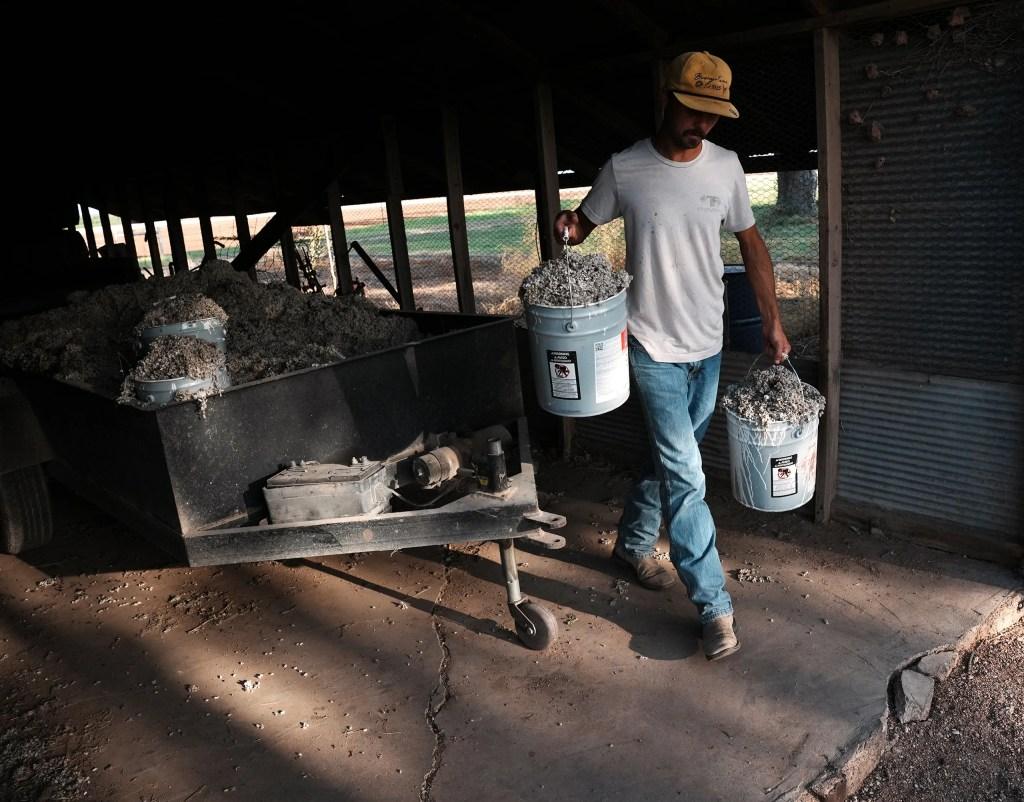
LUBBOCK — Cheyenne Buerger gazes out of his Stamford home at an invaluable asset in Texas: sprawling acres of farmland. His family has cultivated this land for over a century, and Buerger represents the fourth generation overseeing the 6,000 acres dedicated to cotton, wheat, and milo. With additional rented land near Haskell, Buerger’s farming operation was substantial until a landlord sold 600 acres to a third-party for a Google data center, leaving him with an abrupt eviction notice.
“When I explained that I had a crop on it, they said, ‘You can finish it, but that’s it,’” Buerger recounted. “‘You’ve got to be done in 60 days, and you’re out.’”
As the expansion of data centers increasingly encroaches on rural landscapes, the agricultural sector grows anxious about its future viability, forced to compete with these facilities for essential resources such as land, water, and electricity. Plans for at least 248 data centers in Texas have emerged, with rural areas being the most attractive due to their inexpensive and expansive flat land. National statistics indicate that 67% of data centers are situated in rural regions.
For decades, Texas agriculture has thrived, producing over $963 billion in economic output and contributing nearly $15 billion in exports each year. The state boasts the most farmland in the nation, with 126 million acres reported in 2021. However, rising cultivation costs coupled with prolonged droughts have begun to erode this agricultural foundation. Farmers face escalating expenses for equipment repairs, with some estimates suggesting that the cost of maintaining machinery has nearly doubled in the last 20 years for soybean and corn producers. Land prices are also fluctuating, with some areas, particularly in Far West Texas, experiencing nearly a 16% increase.
The loss of farmland is becoming increasingly apparent. Data from Texas Land Trends shows that the state has lost nearly 3.7 million acres in the past 25 years, with over 1.8 million acres converted to non-agricultural use between 2017 and 2022, though specifics on these conversions remain unclear.
Data center development further complicates the situation for the agricultural community, with three significant projects—Project Matador in the Panhandle, Project Pacifico in Pecos County, and Project Meta in El Paso—anticipated to consume at least 16,000 acres, equivalent to approximately 12,000 football fields. Texas Agriculture Commissioner Sid Miller lamented, “They’re building them on our most valuable, most fertile farmland. Once our farmland is gone and paved over, we’ll never farm it again.”
The rise of data centers has sparked significant public outrage as election season approaches, drawing the attention of politicians and candidates alike, especially given the historically Republican voting patterns in rural Texas. Governor Greg Abbott has faced criticism for not convening a special legislative session to address concerns surrounding data centers.
Clayton Tucker, a Democratic candidate for Texas Agriculture Commissioner, has been actively engaging with communities across the state about data center impacts. “This isn’t about being anti-AI or anti-economic development,” Tucker stated. “This is a major threat to Texas the way they’re currently being developed. Right now, the only correct answer is a complete pause. Let’s be smart about this.”
Nate Sheets, Tucker’s Republican opponent and the victor in the March Republican primary, expressed that while he is not opposed to data centers, there needs to be a financial incentive for these companies to operate responsibly. He emphasized that while data centers do not create many jobs, they could contribute to funds that benefit local communities.
“The best thing we can do for a partnership between agriculture and data centers is to ensure that companies invest their resources into addressing the existing challenges we face in Texas,” Sheets remarked. “We need to ensure they’re investing in the future of Texas, not just taking from it.”
Buerger’s farm is situated just four miles from the construction site of the data center in Haskell, a small town approximately 60 miles north of Abilene. The roads he relies on to transport farming equipment have become congested and damaged due to heavy traffic from construction vehicles. Buerger noted that construction lights now shine through his windows around the clock.
“It makes me feel a little threatened just from losing land to data centers,” Buerger admitted. “We can’t compete with that.”
The push for industrial development in rural areas has been a growing concern. Previously, farmers and ranchers were apprehensive about large solar farms encroaching on their land, with estimates suggesting that over 1.5 million acres of farmland could be converted into solar installations by 2024.
As of now, Cleanview, a company monitoring power infrastructure and data center growth, reports that 240 utility-scale solar farms occupy rural lands. Comparatively, an analysis reveals that Texas hosts 335 operational data centers, with numerous projects underway or planned.
With both data centers and solar farms acquiring farmland, Buerger worries about the future of his property. “They’re going to expand,” he stated. “Depending on how many they choose to establish in our area, myself and many other farmers may find ourselves losing significant portions of our land.”
Further northwest, rancher Chris Grotegut is aware that his land in Hereford may soon be in demand. He expects a 765-kv transmission line being constructed nearby will eventually cross his property. Despite this, he remains unperturbed about data centers.
Grotegut attended a community meeting hosted by Google regarding its four-phase data center project, dubbed Project Roman. The first phase will occupy 3,700 acres, with additional land set aside for a solar and wind farm to power the facility. He anticipates that once fully operational, the project could encompass over 180,000 acres.
He was intrigued to learn that Google plans to convert land into expansive grasslands as part of its water management strategy. “They have to ensure their actions are sustainable because they’re depending on the same resources,” Grotegut observed.
Meanwhile, Eric Simpson, who manages the At’l Do Farms corn maze near Shallowater, is increasingly focused on water availability. Just 20 miles away, a data center is under construction in Abernathy, prompting him to rethink his water usage. “To look on my farm right now and see green plants is somewhat deceptive,” he reflected. “We’re only able to maintain that because I can still pump water. Now I find myself contemplating how to adapt to a future where I may no longer have that capability.”
The High Plains generate over $5 billion annually in agricultural revenue, primarily thanks to the Ogallala Aquifer, which has supported farming since its discovery in the region. However, the aquifer is facing depletion, and projections suggest a 25% decline in groundwater availability by 2070, largely due to diminishing supplies from the Ogallala and Edwards-Trinity aquifers in West Texas.
Residents are apprehensive about data centers tapping into this fragile aquifer. Robert Mace, executive director at the Meadows Center for Water and the Environment, noted that the water consumption of a data center depends on its cooling methods and energy requirements. While many plans indicate a preference for closed-loop systems that recycle water, Mace pointed out the irony of data centers establishing themselves in a drier region where water is more accessible due to the rule of capture, which allows landowners to pump a certain amount of groundwater.
While companies must obtain approval from local groundwater districts to drill wells, these districts cannot halt landowners from extracting water. Mace cautioned that the impact on the Ogallala may not be immediately noticeable. “It’s unlikely that a data center activates a well and suddenly yours runs dry,” he explained. “However, instead of the aquifer lasting 30 years before irrigation ceases, it could only last 25. It’s another straw in the aquifer drawing water out.”
Simpson has shifted toward regenerative agriculture to conserve water, which includes growing cover crops in winter and diversifying crop species. He is already strategizing for a time when water might no longer be available. “With another major water consumer entering the Llano Estacado and across the U.S., agriculture is going to suffer,” he predicted. “Particularly in arid regions.”
Grotegut believes the region will retain some water resources, but the situation will change. “It will just be tighter and more expensive,” he stated. “And that’s not just a Panhandle issue; it’s a problem across Texas.”
Clouds reflect the setting sun over Lake Stamford in Haskell County, just over two miles from the site of the Google data center.